1986 world cup standings
FIFA is looking to keep travel light for teams in the group stage, which is why the U.S. will be based in the west coast for the three group games. The team also has operations in Carson, Calif https://montrealpromotionalproducts.net/costaricanationalfootballteamfifaworldcupgames/., which is close to SoFi Stadium that further reduces the travel burden.
The 2014 World Cup marked the end of the FIFA World Cup on ABC and ESPN. Ian Darke, Steve McManaman, and Taylor Twellman was the lead broadcast team, Jon Champion and Stewart Robson were the #2 team. Other play-by-play announcers were: Derek Rae, Adrian Healey, Daniel Mann, and Fernando Palomo. Color commentators: Craig Burley, Efan Ekoku, Roberto Martínez, Kasey Keller, and Alejandro Moreno. All commentators were in Brazil with the top 5 teams at the stadiums while the remaining team called matches off monitors in Rio. Mike Tirico was the lead studio host alongside other hosts Bob Ley and Lynsey Hipgrave with analysts: Alexi Lalas, McManaman, Michael Ballack, Moreno, Keller, Gilberto Silva, Santiago Solari, Martínez, Twellman, and Ruud van Nistelrooy. Reporters included: Jeremy Schaap (Lead), Julie Foudy, Bob Woodruff, John Sutcliffe, Rubens Pozzi.
CHICAGO (Feb. 4, 2024) – The U.S. Men’s National Team will play group stages matches in Los Angeles, Calif., and Seattle, Wash., at the 2026 FIFA World Cup, as announced by FIFA on Sunday afternoon. During a nationally televised broadcast on FOX and Telemundo which included an appearance by USMNT head coach Gregg Berhalter, the sport’s governing body revealed the tournament’s full schedule, which will culminate with the final to be played in New York/New Jersey at MetLife Stadium. The quadrennial tournament is set to take place across the United States, Canada, and Mexico from June 11-July 19, 2026.
The United States participated in the inaugural World Cup in 1930 and finished in the semifinals, which was later declared a third-place finish, their best result to date. The tournament also featured the first hat-trick scored at a World Cup, awarded to American striker Bert Patenaude following recognition by FIFA in 2006. After the 1950 World Cup, in which the United States upset England in group play 1–0, the U.S. was absent from the tournament until 1990. The United States participated in every World Cup from 1990 through 2014, but did not qualify in 2018, marking first time the team had missed a World Cup since 1986. They returned to the World Cup by qualifying for the 2022 edition.
The success of the U.S. team, which advanced to the round of 16 for the first time since 1930, helped boost already high U.S. television ratings. Approximately 11 million Americans were tuned in to the USA vs. Brazil Round of 16 match, an all-time high for soccer in the United States.
1986 world cup standings
The 1986 FIFA World Cup was the 13th FIFA World Cup, a quadrennial football tournament for men’s senior national teams. It was played in Mexico from 31 May to 29 June 1986. The tournament was the second to feature a 24-team format. Colombia had been originally chosen to host the competition by FIFA but, largely due to economic reasons, was not able to do so, and resigned in November 1982. Mexico was selected as the new host in May 1983, and became the first country to host the World Cup more than once, after previously hosting the 1970 edition.
All of these venues except Monterrey were located in central Mexico, as this tournament was organized with the then-standard way of keeping teams playing in locations in close proximity to each other. Group A only played at the Olimpico and in Puebla (except for the Bulgaria-Italy opening tournament match, which was played in the Azteca), Group B only played at the Azteca and in Toluca (hosts Mexico were part of this group; they played all their group stage matches at the Azteca), Group C played in León and Irapuato, Group D only played in Guadalajara (including the Guadalajara area town of Zapopan; the last match of this group was played in Monterrey), Group E exclusively played in Querétaro and Nezahualcóyotl, and Group F played in the northern city of Monterrey (including the Monterrey area town of San Nicolas de los Garza; the last match of this group was played in Guadalajara). All of the venues listed hosted knockout round matches except the ones in Nezahualcoyotl, Irapuato, Zapopan, Toluca and the Estadio Tecnologico in Monterrey.

The 1986 FIFA World Cup was the 13th FIFA World Cup, a quadrennial football tournament for men’s senior national teams. It was played in Mexico from 31 May to 29 June 1986. The tournament was the second to feature a 24-team format. Colombia had been originally chosen to host the competition by FIFA but, largely due to economic reasons, was not able to do so, and resigned in November 1982. Mexico was selected as the new host in May 1983, and became the first country to host the World Cup more than once, after previously hosting the 1970 edition.
All of these venues except Monterrey were located in central Mexico, as this tournament was organized with the then-standard way of keeping teams playing in locations in close proximity to each other. Group A only played at the Olimpico and in Puebla (except for the Bulgaria-Italy opening tournament match, which was played in the Azteca), Group B only played at the Azteca and in Toluca (hosts Mexico were part of this group; they played all their group stage matches at the Azteca), Group C played in León and Irapuato, Group D only played in Guadalajara (including the Guadalajara area town of Zapopan; the last match of this group was played in Monterrey), Group E exclusively played in Querétaro and Nezahualcóyotl, and Group F played in the northern city of Monterrey (including the Monterrey area town of San Nicolas de los Garza; the last match of this group was played in Guadalajara). All of the venues listed hosted knockout round matches except the ones in Nezahualcoyotl, Irapuato, Zapopan, Toluca and the Estadio Tecnologico in Monterrey.
Morocco topped Group F after holding both Poland and England to goalless draws, and beating Portugal 3–1. By doing so, they became the first African team, and only the second nation from outside Europe and the Americas (after North Korea in 1966), to reach the second round. England lost 1–0 to Portugal, followed by a 0–0 draw against Morocco in which they lost captain Bryan Robson to injury (for the remainder of the tournament) and vice-captain Ray Wilkins to a red card (he was not selected for the remainder of the tournament, even after having served his obligatory one-match ban). In their last first-round game, with the captaincy taken over by Peter Shilton in goal, a first-half Gary Lineker hat-trick helped the reshaped side beat Poland 3–0 – although losing yet another player to a ban for the next round, Terry Fenwick receiving his second booking of the tournament. Poland had previously beaten Portugal, and in the end the Portuguese were the only team from Group F to be eliminated in the first round. Portugal, making their first appearance in 20 years, went on strike (in the Saltillo Affair) during the competition. Players refused to train between their first and second games (against England and Poland) and were eliminated after a loss to Morocco in the final group match.
The World Cup was won by Argentina (their second title, after winning in 1978). Argentina was captained by the 25-year-old Diego Maradona, who played a large part in his team’s success by scoring his «Hand of God» goal, as well as another voted the «Goal of the Century», in the same quarter-final against England. These were two of the five goals that Maradona scored during the tournament, and he also created another five for his teammates. Argentina beat West Germany 3–2 in the final at Mexico City’s Estadio Azteca. Argentina would not win the World Cup again until 2022, 36 years later. Total attendance was 2,394,031, an average per match of 46,039. Canada, Denmark and Iraq made their first appearances at the final stage.
1990 world cup host
Cameroon defeated world champions Argentina 1–0. Despite ending the match with only nine men, the African team held on for a shock 1–0 win, with contrasting fortunes for the Biyik brothers: François Omam scoring the winning goal with a downward header, shortly after seeing Andre Kana sent off for a serious foul. In their second game the introduction of Roger Milla was the catalyst for a 2–1 win over Romania, Milla scoring twice from the bench (making him the oldest goalscorer in the tournament). With progression assured, Cameroon slumped to a 4–0 defeat in their final group game to the Soviet Union (in what would be their last World Cup due to the dissolution of the Soviet Union), who were striving to stay in the tournament on goal difference after successive 2–0 defeats. Argentina lost their veteran goalkeeper, Nery Pumpido, to a broken leg during their victory over the USSR: his replacement, Sergio Goycochea, proved to be one of the stars of their tournament. In the final match, a 1–1 draw between Romania and Argentina sent both through, equal on points and on goal difference but Romania having the advantage on goals scored: Romania were thus second, Argentina qualified as one of the best third-placed teams.
Italy became the second country, after Mexico, to host two World Cups when their bid was preferred in competition with England, Soviet Union and Greece. The upgrading of stadiums took more time than planned and the organizers feared they would have to start the competition with some of the stadiums unfinished, but everything was perfect by June 8th 1990 – the date for the opening match in Milan. The only thing that went wrong was the official opening of the tournament and the order of speeches. FIFA President Joao Havelange waited for the President of the Organizing Committee to hold his speech and vice versa. So no speeches were held. Cameroon kept their unbeaten run in the World Cup (3 draws in 1982) after the opening match against defending champions Argentina. Omam-Biyick headed past Pumpido and gave the Africans a sensational 1-0 win. The Indomitable Lions had more in store and beat Romania in the following match with the hero being a 38 year old semi-retired substitute. Roger Milla burst onto the scene with two magnificent goals and became an instant favourite among neutral fans around the world. He took his team all the way to the quarterfinals and a legendary match with England. Prior to that game he had scored two more brilliant goals against Colombia in the round of 16. Both again as substitute. He helped Cameroon turn the game against England when he came on at half-time, but two late penalties by Lineker ended the dream for the Lions. Cameroon’s successful run along with Egypts respectable showing made FIFA increase Africa’s quota of spots from two to three for USA ’94. England had a tiresome World Cup and got nothing for free. Three tight matches in the groupstage were followed by three more matches that went to extra-time, the last against West Germany, even to penalties. Paul Gascoigne had a fine tournament and Lineker got better as the tournament progressed and scored four goals. Italia ’90 was a World Cup for the old powers. All the previous winners were present. All the previous winners survived the groupstage and the semifinal places were occupied by four of the five best teams on the all-time ranking. Only Brazil disappointed and lost against Argentina against the run of play in the second round. A single Maradona-Caniggia combination was enough to send Careca and company home. Maradona showed glimpses, like against Brazil, of his old self but couldn’t fully repeat what he did in 1986. Argentina were a shadow of the side that triumphed in Mexico, but they were tactically and mentally strong and knew how to survive in international football. 22 yellow and 3 red cards gave them many suspensions, but they always found a way to get by much thanks to an unlikely hero; goalkeeper Sergio Goycoechea who came on only because first choice keeper Pumpido broke his leg early in the tournament. Goycoechea was the hero in consecutive penalty shoot-outs. First against Yugoslavia and then in the semifinal against Italy where he saved efforts from Donadoni and Serena. Italy had until midway through the second half of that semifinal not conceded a single goal in the tournament before Caniggia headed past Walter Zenga who was out of position. Unbeaten for 517 minutes is a World Cup record. Another record was West Germany’s three consecutive appearances in the Final of a World Cup. Lothar Matth�us and Pierre Littbarski were members of the two previous silvermedal teams, but in Italy it was glory at third attempt for them. Matth�us was the best player of the tournament. A great spielf�hrer who worked all over the pitch and contributed with four goals. The team had two strong forwards in V�ller and Klinsmann, plus a very good left-back in Brehme and as always with German teams – a well organized defence. They did lack creative forces in midfield other than Matth�us’ running and relied heavily on set pieces to win games in the latter stages. Only three goals scored from the quarterfinal onwards with two of them coming from penalties is a rather poor record for a World Cup winning team although they did impress with a 4-1 win over powerful Yugoslavia in the preliminary round. Another team who definitely had a poor record was the Netherlands who arrived in Italy as hot favourites to win the cup, but fell flat and didn’t win a single match in the tournament. Van Basten failed to score and Gullit had just come back from injury and was out of shape. The Netherlands did give West Germany a good match in the second round, which might also have been the best performance by the eventual winners, but the World Cup missed the Dutch flair and style of Euro 88 as the tournament went into its final rounds. That match in Milan was marred by the expulsions of Rijkaard for spitting and V�ller for pushing and alledged abusive racial comments. Sixteen players were sent off at Italia ’90. More than at Mexico ’86 and Espa�a ’82 combined. Fans are stuck with lots of other negative impressions from this World Cup. Pedro Monzon of Argentina became the first man to be sent off in a Final and Dezotti followed shortly after as Argentina finished with nine men. Italia ’90 was also the lowest scoring tournament ever. Ireland got to the quarterfinal without winning a single match and scored only two goals in total. The Soviets were title challengers before the tournament, but never showed signs of being capable of winning and ended dead last in their group with a bunch of ageing has-beens. Not even Brazil impressed in attack and coach Lazaroni used five out-and-out defenders in his starting line-up. Most teams played to avoid losing rather than to win. This was especially evident in the knock-out stage when half the matches went to extra-time and/or penalties. On the bright side we had Cameroon as pointed out earlier and also Costa Rica who put Sweden and Scotland behind them and advanced through to the second round. With Mexico banned for illegal use of overaged players in a FIFA youth tournament and the US only in Italy to learn, most people predicted a poor showing by Concacaf in this tournament, but Costa Rica gave their confederation some fine moments when it needed it the most. 1990 was definitely a year for unlikely heroes. Milla and Goycoechea are already mentioned and so should Salvatore Schillaci be. He who took over the role Gianluca Vialli was supposed to have as hero for the host nation. Schillaci scored six goals and became topscorer. He scored in six different matches and opened his account as a substitute against Austria and closed it with a goal against England that secured bronzemedals for Italy. He never found this form again and faded quickly after the World Cup.
In order to avoid any future boycotts or controversy, FIFA began a pattern of alternation between the Americas and Europe, which continued until the 2002 FIFA World Cup in Asia. The system evolved so that the host country is now chosen in a vote by FIFA’s Congress. This is done under an exhaustive ballot system. The decision is currently made roughly seven years in advance of the tournament, though the hosts for the 2022 tournament were chosen at the same time as those for the 2018 tournament.
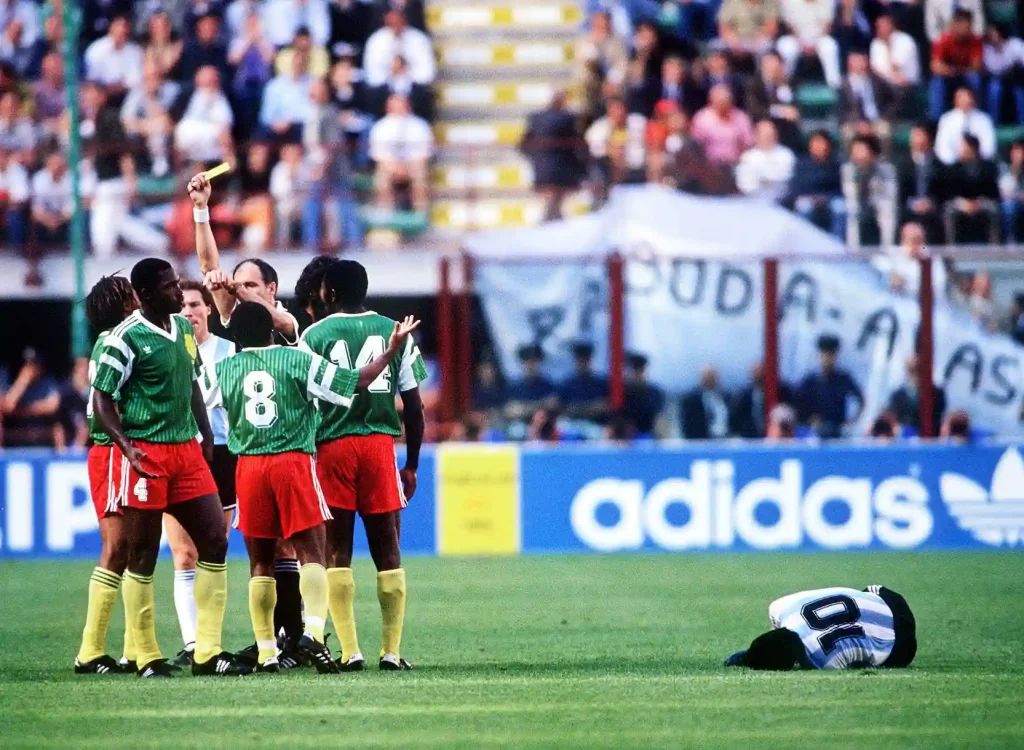
Cameroon defeated world champions Argentina 1–0. Despite ending the match with only nine men, the African team held on for a shock 1–0 win, with contrasting fortunes for the Biyik brothers: François Omam scoring the winning goal with a downward header, shortly after seeing Andre Kana sent off for a serious foul. In their second game the introduction of Roger Milla was the catalyst for a 2–1 win over Romania, Milla scoring twice from the bench (making him the oldest goalscorer in the tournament). With progression assured, Cameroon slumped to a 4–0 defeat in their final group game to the Soviet Union (in what would be their last World Cup due to the dissolution of the Soviet Union), who were striving to stay in the tournament on goal difference after successive 2–0 defeats. Argentina lost their veteran goalkeeper, Nery Pumpido, to a broken leg during their victory over the USSR: his replacement, Sergio Goycochea, proved to be one of the stars of their tournament. In the final match, a 1–1 draw between Romania and Argentina sent both through, equal on points and on goal difference but Romania having the advantage on goals scored: Romania were thus second, Argentina qualified as one of the best third-placed teams.
Italy became the second country, after Mexico, to host two World Cups when their bid was preferred in competition with England, Soviet Union and Greece. The upgrading of stadiums took more time than planned and the organizers feared they would have to start the competition with some of the stadiums unfinished, but everything was perfect by June 8th 1990 – the date for the opening match in Milan. The only thing that went wrong was the official opening of the tournament and the order of speeches. FIFA President Joao Havelange waited for the President of the Organizing Committee to hold his speech and vice versa. So no speeches were held. Cameroon kept their unbeaten run in the World Cup (3 draws in 1982) after the opening match against defending champions Argentina. Omam-Biyick headed past Pumpido and gave the Africans a sensational 1-0 win. The Indomitable Lions had more in store and beat Romania in the following match with the hero being a 38 year old semi-retired substitute. Roger Milla burst onto the scene with two magnificent goals and became an instant favourite among neutral fans around the world. He took his team all the way to the quarterfinals and a legendary match with England. Prior to that game he had scored two more brilliant goals against Colombia in the round of 16. Both again as substitute. He helped Cameroon turn the game against England when he came on at half-time, but two late penalties by Lineker ended the dream for the Lions. Cameroon’s successful run along with Egypts respectable showing made FIFA increase Africa’s quota of spots from two to three for USA ’94. England had a tiresome World Cup and got nothing for free. Three tight matches in the groupstage were followed by three more matches that went to extra-time, the last against West Germany, even to penalties. Paul Gascoigne had a fine tournament and Lineker got better as the tournament progressed and scored four goals. Italia ’90 was a World Cup for the old powers. All the previous winners were present. All the previous winners survived the groupstage and the semifinal places were occupied by four of the five best teams on the all-time ranking. Only Brazil disappointed and lost against Argentina against the run of play in the second round. A single Maradona-Caniggia combination was enough to send Careca and company home. Maradona showed glimpses, like against Brazil, of his old self but couldn’t fully repeat what he did in 1986. Argentina were a shadow of the side that triumphed in Mexico, but they were tactically and mentally strong and knew how to survive in international football. 22 yellow and 3 red cards gave them many suspensions, but they always found a way to get by much thanks to an unlikely hero; goalkeeper Sergio Goycoechea who came on only because first choice keeper Pumpido broke his leg early in the tournament. Goycoechea was the hero in consecutive penalty shoot-outs. First against Yugoslavia and then in the semifinal against Italy where he saved efforts from Donadoni and Serena. Italy had until midway through the second half of that semifinal not conceded a single goal in the tournament before Caniggia headed past Walter Zenga who was out of position. Unbeaten for 517 minutes is a World Cup record. Another record was West Germany’s three consecutive appearances in the Final of a World Cup. Lothar Matth�us and Pierre Littbarski were members of the two previous silvermedal teams, but in Italy it was glory at third attempt for them. Matth�us was the best player of the tournament. A great spielf�hrer who worked all over the pitch and contributed with four goals. The team had two strong forwards in V�ller and Klinsmann, plus a very good left-back in Brehme and as always with German teams – a well organized defence. They did lack creative forces in midfield other than Matth�us’ running and relied heavily on set pieces to win games in the latter stages. Only three goals scored from the quarterfinal onwards with two of them coming from penalties is a rather poor record for a World Cup winning team although they did impress with a 4-1 win over powerful Yugoslavia in the preliminary round. Another team who definitely had a poor record was the Netherlands who arrived in Italy as hot favourites to win the cup, but fell flat and didn’t win a single match in the tournament. Van Basten failed to score and Gullit had just come back from injury and was out of shape. The Netherlands did give West Germany a good match in the second round, which might also have been the best performance by the eventual winners, but the World Cup missed the Dutch flair and style of Euro 88 as the tournament went into its final rounds. That match in Milan was marred by the expulsions of Rijkaard for spitting and V�ller for pushing and alledged abusive racial comments. Sixteen players were sent off at Italia ’90. More than at Mexico ’86 and Espa�a ’82 combined. Fans are stuck with lots of other negative impressions from this World Cup. Pedro Monzon of Argentina became the first man to be sent off in a Final and Dezotti followed shortly after as Argentina finished with nine men. Italia ’90 was also the lowest scoring tournament ever. Ireland got to the quarterfinal without winning a single match and scored only two goals in total. The Soviets were title challengers before the tournament, but never showed signs of being capable of winning and ended dead last in their group with a bunch of ageing has-beens. Not even Brazil impressed in attack and coach Lazaroni used five out-and-out defenders in his starting line-up. Most teams played to avoid losing rather than to win. This was especially evident in the knock-out stage when half the matches went to extra-time and/or penalties. On the bright side we had Cameroon as pointed out earlier and also Costa Rica who put Sweden and Scotland behind them and advanced through to the second round. With Mexico banned for illegal use of overaged players in a FIFA youth tournament and the US only in Italy to learn, most people predicted a poor showing by Concacaf in this tournament, but Costa Rica gave their confederation some fine moments when it needed it the most. 1990 was definitely a year for unlikely heroes. Milla and Goycoechea are already mentioned and so should Salvatore Schillaci be. He who took over the role Gianluca Vialli was supposed to have as hero for the host nation. Schillaci scored six goals and became topscorer. He scored in six different matches and opened his account as a substitute against Austria and closed it with a goal against England that secured bronzemedals for Italy. He never found this form again and faded quickly after the World Cup.
In order to avoid any future boycotts or controversy, FIFA began a pattern of alternation between the Americas and Europe, which continued until the 2002 FIFA World Cup in Asia. The system evolved so that the host country is now chosen in a vote by FIFA’s Congress. This is done under an exhaustive ballot system. The decision is currently made roughly seven years in advance of the tournament, though the hosts for the 2022 tournament were chosen at the same time as those for the 2018 tournament.